


Continued Service and Increased Access: King County Coordinated Vaccine Transportation Helpline
October 6, 2021
Story Update
(October 8, 2021)
Transportation remains a critical element to access the COVID-19 vaccine. As boosters become available, we want to remind you and your clients that the Hopelink Mobility team is here to assist with transportation to and from Vaccine appointments.
While some services have changed through the summer and early fall, the Coordinated Vaccine Transportation Helpline
(The Helpline) remains available to assist in gaining access to these critical vaccines. Hopelink Mobility Staff can be available to assist with Pop-up clinics either by scheduling rides in advance or attending the event and helping individuals get home.
This service is available to anyone
who calls. However, for vaccine trips, we often refer to specialized transportation providers who may have specific eligibility requirements. Our staff will listen to your needs and find a solution that fits.
• Current Hours of Operation: Monday – Friday, 8:30 am – 4:00 pm
• Phone Number: 425-943-6706
• Language Assistance: Please state your language in English and staff will connect an interpreter
• Online Intake Form: https://bit.ly/3rcuoIK
If no one answers, please leave a voicemail, and we will call you back as soon as we can. If you call outside of business hours, we will return your call the next business day.
Promotion and resources are available for you to download and distribute in many languages! Coordinated Vaccine Transportation Helpline Flyers:
• English
• Amharic
• Arabic
• Dari
• French
• Korean
• Lingala
• Russian
• Somali
• Spanish
• Swahili
• Tagalog
Continue reading below the dashes for the original post detailing this resource.
___
For many communities across King County, transportation is a constant barrier to getting to their doctor’s appointments, grocery stores and social gatherings. This barrier was made even more complex by the COVID-19 pandemic. Individuals – especially older adults, people with disabilities, people with limited English and members of the BIPOC community – faced some of the most significant barriers. As the COVID-19 vaccine began to roll out in January, it was clear that transportation continued to be an obstacle. Many of the populations most in need of the vaccine were unable to safely and reliably get to their vaccine appointment.
This need prompted Hopelink to think creatively on how to be part of the solution. In addition to launching the King County COVID Vaccine Mobility Task Force, Hopelink created the Coordinated Vaccine Transportation Helpline. This Helpline is a one-stop-shop for finding and securing transportation support to and from vaccine appointments in and around King County. Individuals, caregivers, caseworkers, medical professionals, vaccine schedulers and others can receive individualized support for themselves or the rider they are helping through either an online intake form
or by calling 425-943-6706 (press 5 for language assistance). There is no eligibility criteria, and the ride is free in most circumstances.
This program aims to support communities that are the most vulnerable and need access to the vaccine sites; this includes BIPOC communities, seniors, immigrants, refugees and individuals with disabilities.
“We want to ensure transportation is not the barrier to accessing the vaccine in our community,” says Staci Sahoo, Director of Mobility Management at Hopelink.
The Helpline was launched in late February and is staffed by Hopelink team members who are bilingual in English/Spanish, and staff also have access to interpretation services at the time of the call. The Helpline reservation line is open Monday through Friday, from 8:30 a.m. to 4 p.m. You can also leave a voicemail and get a callback.
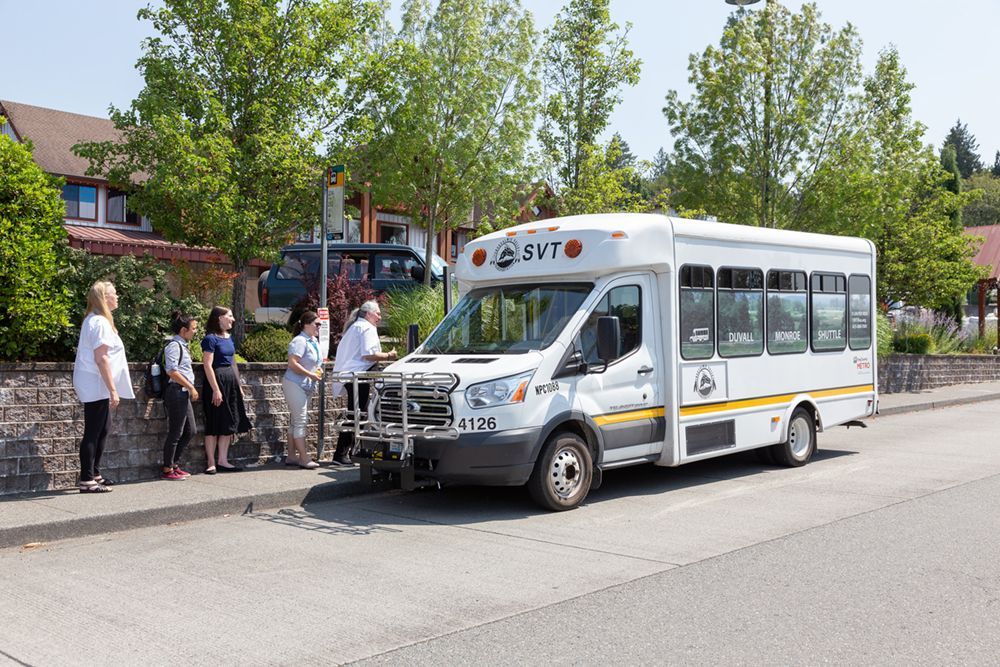
The success of this Helpline is because of the incredible partnerships that were created. This includes Sound Generations(Hyde Shuttle & Volunteer Driver Program), Catholic Community Services of Western Washington(King County Volunteer Services), King County Metro(Access, Community Van, Crossroads Connect, Via to Transit), Snoqualmie Valley Transportation, Northshore Senior Center, Puget Sound Educational Service District, Hopelink’s Non-Emergency Medical Transportation, Lyft, and Uber. These partners have stepped up to provide access to transportation to vaccine appointments and provided them at no cost.
The success of this program is highlighted by an older Hispanic couple who called for a next-day trip. English was not their primary language, and they were nervous about riding public transit. They were afraid they would get lost, but they also feared being harassed for being immigrants. Traveling from Kirkland to Seattle with such short notice, options were limited; however, this ride was able to be fulfilled in partnership with King County Metro’s Community Van. In addition, they were able to ride again to receive their second shot.
“No one should second-guess how they will get to their vaccine appointment,” said Sahoo. “We want to put their mind at ease by giving them one less thing to worry about.”
Hopelink is proud to partner with Public Health – Seattle & King County and many other organizations across King County to provide transportation for this critical resource. The Helpline will continue to support the community as long as there is a need, thanks to generous grant partners, including Washington State Department of Transportation, Aging and Disability Services' Community Living Connections, and All in WA’s Vaccine Equity Initiative.
For additional transportation resources, visit: https://www.findaride.org/covid
or call 425-943-6706. A flyer about the Vaccine Transportation Helpline is available in English, Arabic, Chinese, Farsi, Khmer, Korean, Luganda, Portuguese, Russian, Somali, Spanish, Swahili, Tagalog, Wolof, and Vietnamese. For information on the COVID vaccine in King County, visit www.kingcounty.gov/vaccine.
###
About Hopelink
In 2020 Hopelink served nearly 65,000 people in King and Snohomish Counties. Our services are designed to help individuals and families find stability in crisis by meeting basic needs for food, shelter, heat and transportation. In addition, we support people working hard to build a path out of poverty through adult education, financial capabilities classes, help finding a job and family development support through comprehensive case management. Our organization also provides services through a trauma-informed lens, recognizing that the violence of poverty leaves scars, both mental and physical, that have long-term effects on how people perceive the world and choices they make.
Media Contact:
Staci Sahoo
425-625-6856
Mobility News
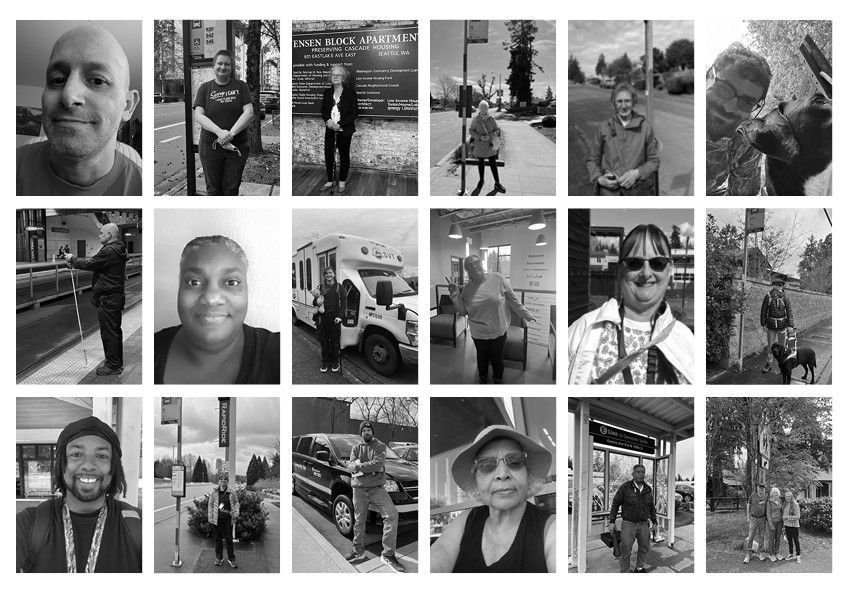
Introducing the Access to Health and Wellbeing Storymap Project
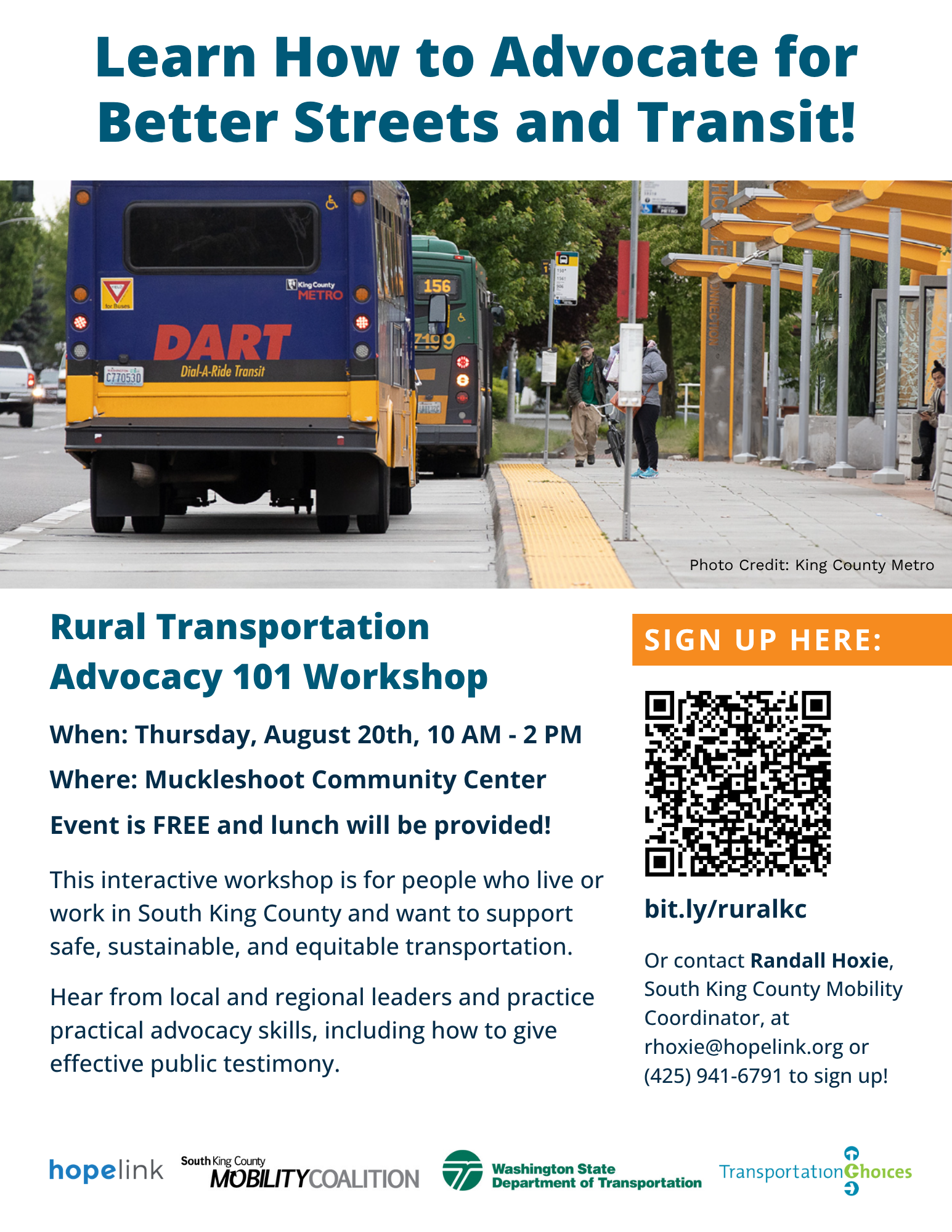
Join Transportation Choices Coalition and the South King County Mobility Coalition for a free advocacy workshop on August 20th.
What is Find a Ride Phase 2? Hopelink Mobility is currently developing the Phase 2 of our One-Call/One-Click program, Find a Ride . Find a Ride already serves as a comprehensive database of transit and specialized transportation services across King, Pierce, and Snohomish counties, along with a trip planner that incorporates those services. In Phase 2, we plan to expand this program by creating a way for Find a Ride users to check their eligibility for several of these services at once. To learn more about Find a Ride Phase 2, read the Find a Ride Phase 2 Readiness blog post or this document explaining the project! Hack for Social Impact Hack for Social Impact is, in their own words, “A 501(c)(3) tech non-profit organization dedicated to solving real-world challenges by connecting engineers and data scientists with non-profits, NGOs, and civic organizations.” Their flagship event is an annual hackathon where nonprofits bring live technology problems for participants to tackle. In April 2026, Hack for Social Impact hosted a hackathon in Seattle in partnership with the Women in Tech Regatta . Hopelink brought Find a Ride Phase 2 as a challenge for the participants, asking them to find a way to streamline eligibility determination processes and applications for transportation services in the Puget Sound Region. More details on this challenge, and our vision for Phase 2, can be find in the Find a Ride “Hack-Pack.” Outputs: Two teams took on the Find a Ride Phase 2 challenge and dedicated several hours to reimagining how people across the Puget Sound region enroll in specialized transportation services. Each took their own unique approach to developing a framework for Phase 2. Hopelink Team - This team focused on the rider experience from intake to approval. Their solution centers on a single application that instantly shows users which services they qualify for, complete with match scores and plain-language explanations for any services they don't qualify for. Key features include: Instant eligibility checking with a match score for each available service One centralized application submitted to individual services for review Upfront document requirements so riders know what they need before they apply Admin dashboard for Hopelink staff to manage vendors, track applications, and access data insights — such as why users declined certain services Client-side application tracker for services with longer approval timelines RideReady Team – This team took a bigger-picture approach, tackling the fragmentation across the nonprofit rideshare landscape. Rather than improving one intake flow, they proposed a statewide verification platform — verify your eligibility once with Hopelink, then use that credential to access dozens of partner organizations, much like logging into a website with your Google account. Key features include: "Verify once, use everywhere" — a single sign-on model compatible with partner rideshare organizations across Washington state Multi-language support — 6 languages available on the web interface, and 57 via a built-in voice chat assistant Voice chat assistant designed for accessibility, particularly for elderly riders and non-English speakers Results: The RideReady team won the Hackathon with their vision of Find a Ride Phase 2! Click here to see the site that they created. This site is a prototype and is meant to serve as proof of concept. The Find a Ride team will be taking insights into consideration from both projects as we develop Phase 2 but will ultimately continue to prioritize input from our partners. What made this hackathon so valuable wasn't just the quality of individual solutions — it was seeing two different teams independently confirm that the same core problems need solving: too much repeated data entry, unclear eligibility, and barriers that make accessing transportation harder than it needs to be. The ideas these teams prototyped, along with feedback from our dedicated partners, will inform how we shape Find a Ride Phase 2. We're grateful to Hack for Social Impact, the Women in Tech Regatta, and every participant who brought their expertise to this challenge. Stay tuned for more updates as Phase 2 continues to take shape! To learn more about Find a Ride Phase 2, read the Find a Ride Phase 2 Readiness blog post on the KCMobility website or join us at a Find a Ride Advisory meeting! For an invite, reach out to Grace Georgitsis at ggeorgitsis@hopelink.org, or by phone at 425-625-6836.
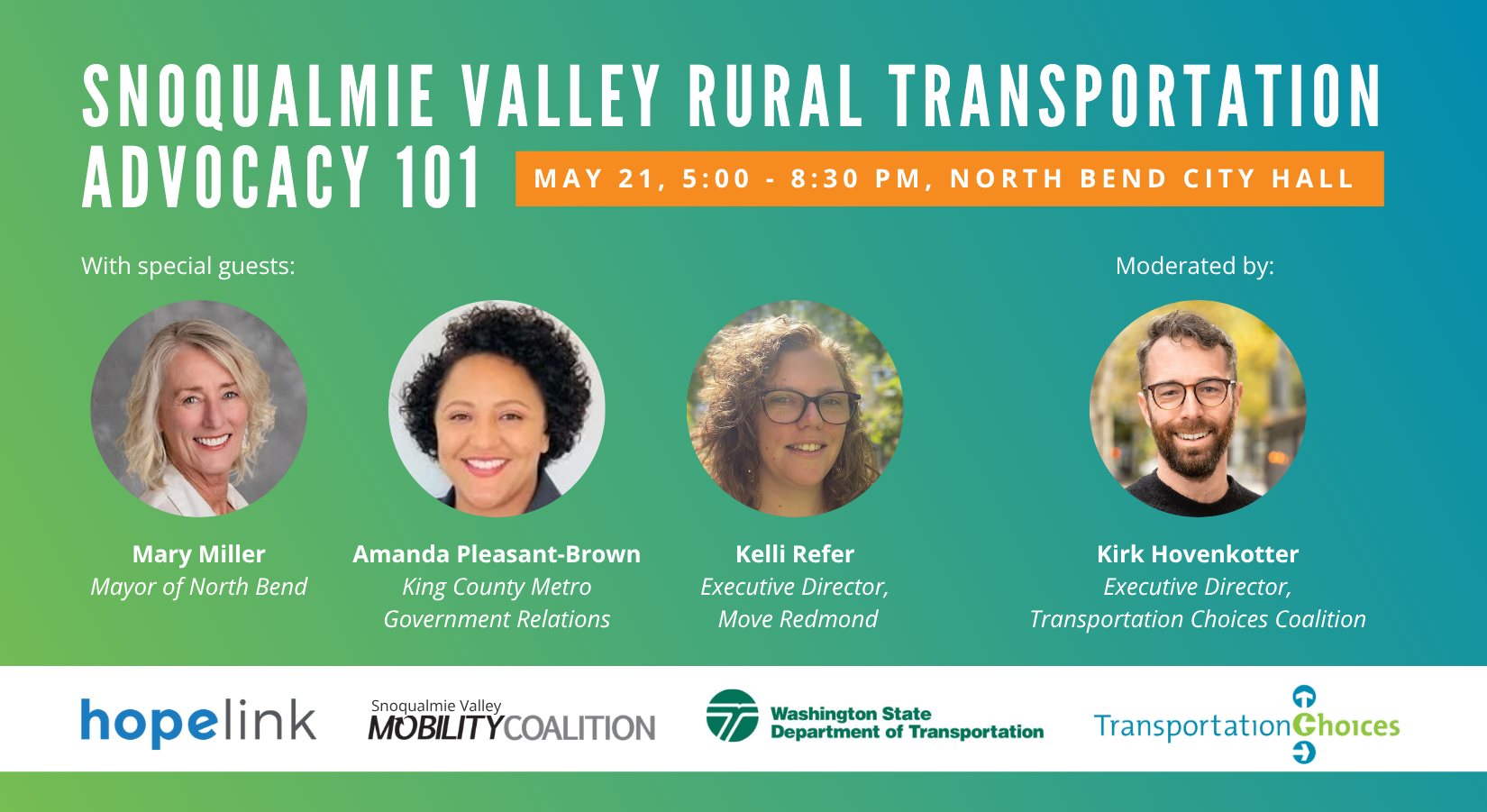
Thursday, May 21st 5:00-8:00pm, North Bend City Hall
With the support of two vendors, Anthro-Tech and Cambridge Systematics, and incorporating feedback from our Mobility Team, various Mobility Coalition Partners and individuals with disabilities, we are excited to bring you an updated version of Find a Ride.
Your Story Matters
Read the full 10-page report here: RARET Flooding 2025 Transportation Report
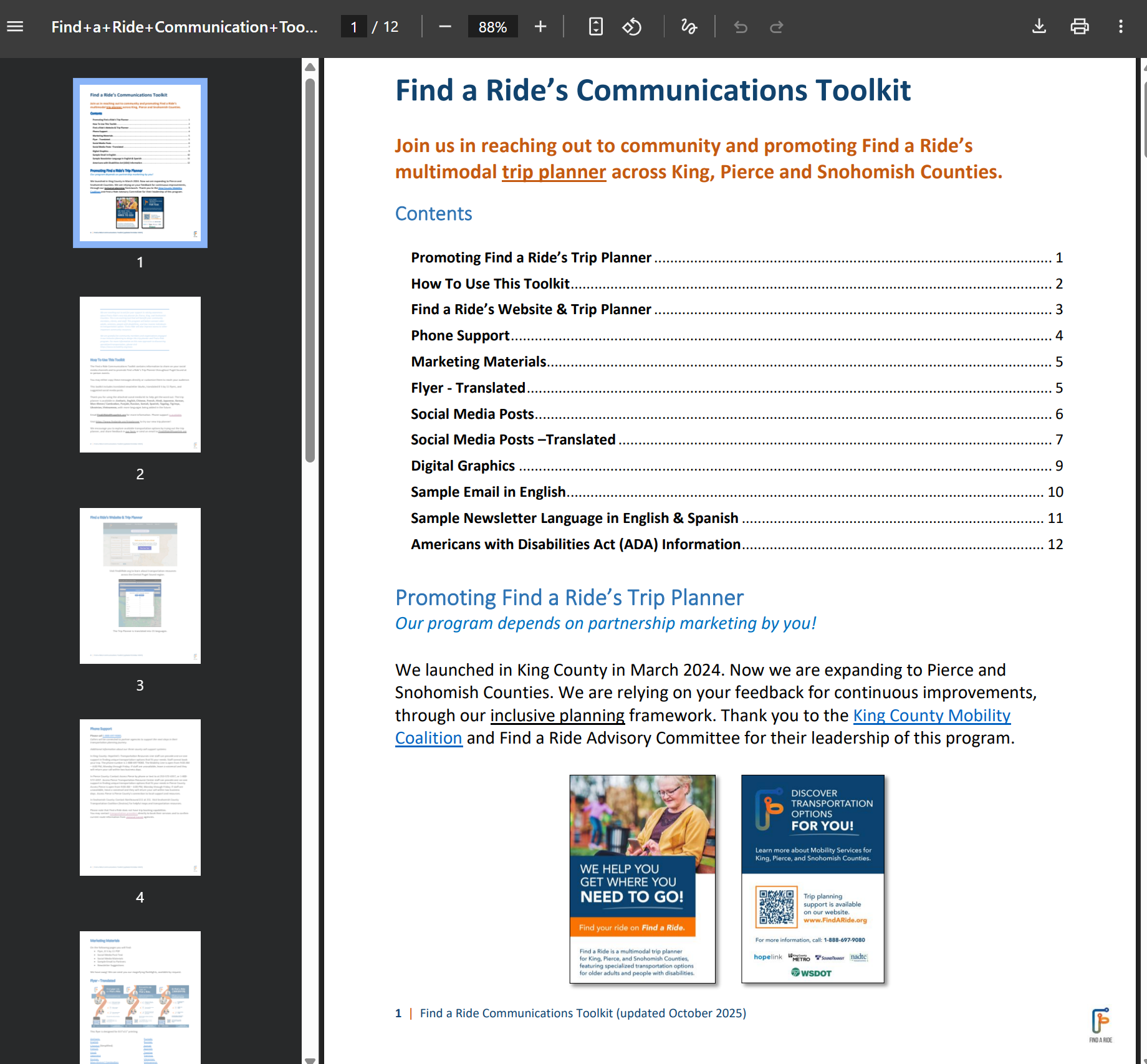
The Find a Ride Communications Toolkit contains information to share on your social media channels and to promote Find a Ride’s Trip Planner throughout Puget Sound at in-person events.
Phase 2 seeks to streamline rules and procedures for rider intake, eligibility determination, and enrollment verification in Puget Sound
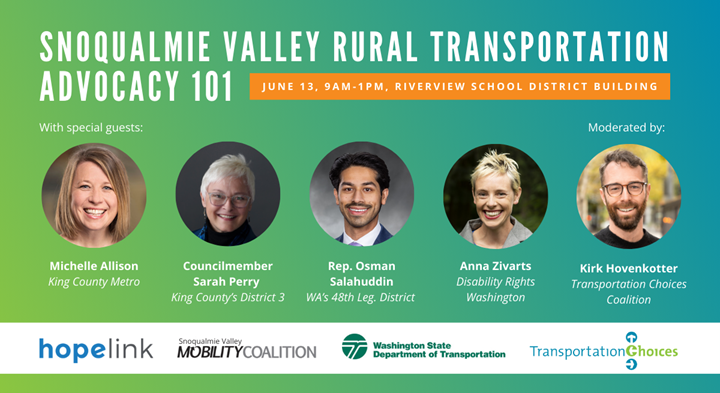
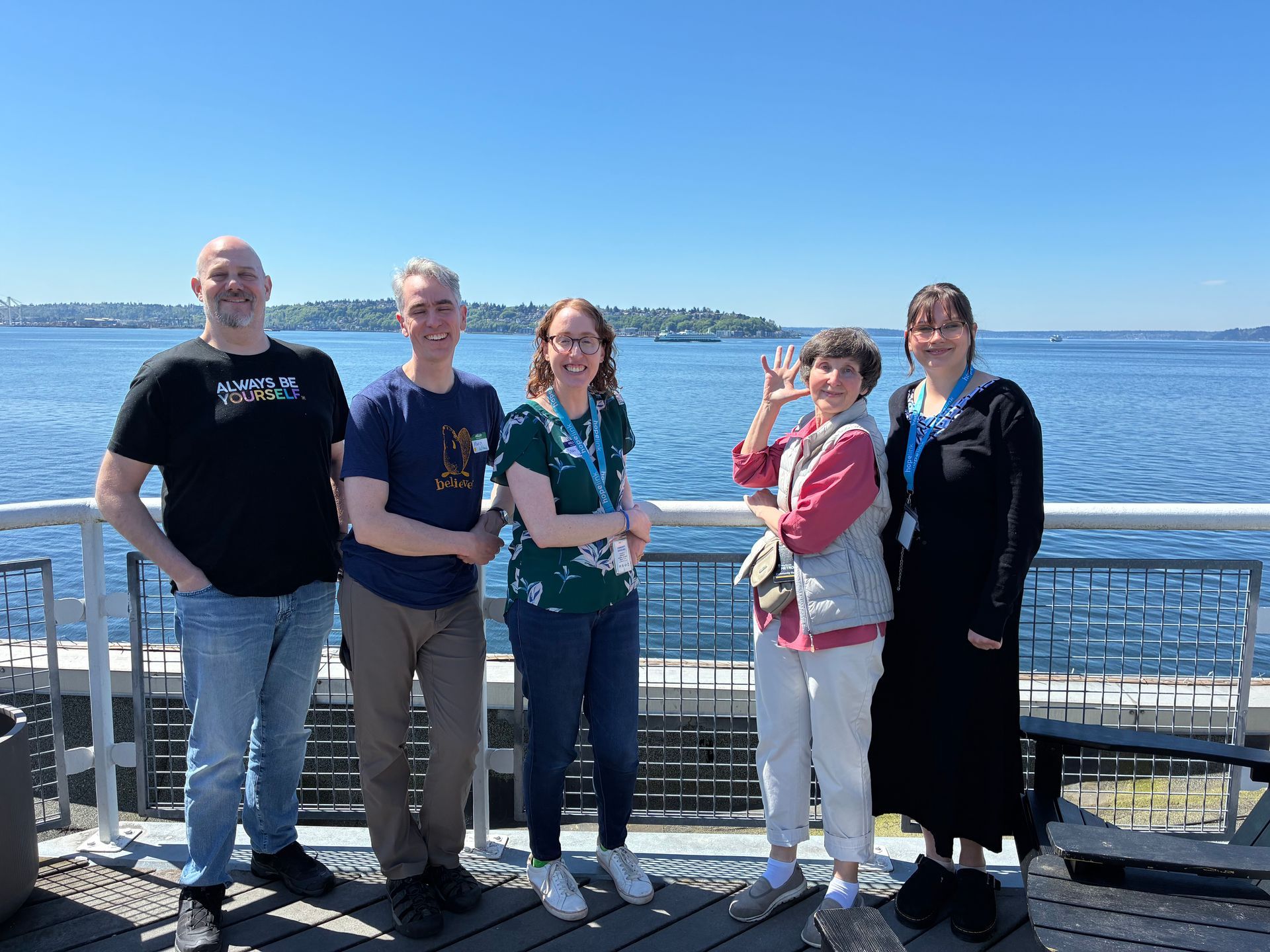
SVMC hosted a Rural Transporation Advocacy 101 Workshop on June 13th, 2025